


 en
en Login
Login

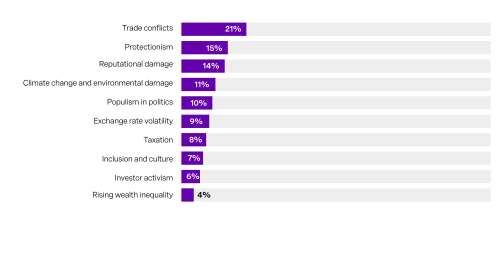
Trade conflicts
Commodity price volatility
Populism in politics
Reputational damage
Climate change and environmental damage
Inclusion and culture
Exchange rate volatility
Taxation
Investor activism
Rising wealth inequality
The availability of key talent and skills continues its steady decline from its peak in 2023, falling to 43% of leaders selecting it as a top-five factor. Workforce transformation has also climbed back into the top five, rising to 37% as organizations increasingly focus on how AI adoption and evolving workforce expectations are reshaping organizational structures and talent needs.
At the same time, uncertain economic growth has moderated somewhat after dominating the rankings for the past several years, while the availability of key talent and skills has steadily declined from its 2023 peak. Geopolitical uncertainty has remained volatile across waves but surged sharply again in H1 2026. Workforce transformation, introduced in H2 2024, has rebounded into the top five after dipping throughout 2025, reflecting growing organizational focus on AI-enabled workforce evolution.
1. Uncertain economic growth
2. Technological change
3. Availability of key talent
4. Geopolitical uncertainty
5. Policy uncertainty
6. Workforce transformation
7. Changes in consumer behavior
8. Increased regulation
9. Cyber threats
10.
Protectionism
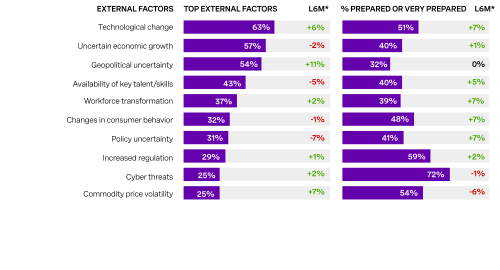
Preparedness to address technological change increased notably in the past six months, rising from 44% to 51%, while preparedness for workforce transformation climbed 7PP in the past six months.
Even so, four of the top five organizational health factors remain at or below 40% preparedness globally. Preparedness for geopolitical uncertainty remains especially low at 32%, despite the sharp increase in leaders identifying it as a top organizational health factor. Cyber threats continue to stand apart as the factor leaders feel most prepared to address, with 72% reporting preparedness.
EXTERNAL FACTORS
TOP EXTERNAL FACTORS
L6M*
% PREPARED OR VERY PREPARED
L6M*
11.
Trade conflicts
12. Commodity price volatility
13.
Populism in politics
14.
Reputational damage
15.
Climate/Environmental change
16.
Inclusion and culture
17.
Taxation
18.
Exchange rate volatility
19.
Investor activism
20.
Rising wealth inequality
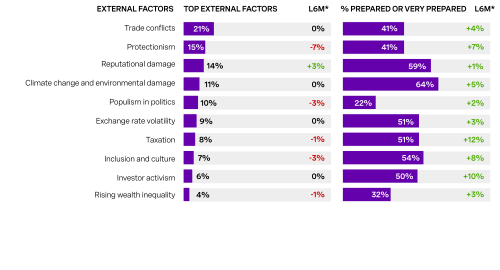
Preparedness to address technological change increased notably in the past six months, rising from 44% to 51%, while preparedness for workforce transformation climbed 7PP in the past six months.
Even so, four of the top five organizational health factors remain at or below 40% preparedness globally. Preparedness for geopolitical uncertainty remains especially low at 32%, despite the sharp increase in leaders identifying it as a top organizational health factor. Cyber threats continue to stand apart as the factor leaders feel most prepared to address, with 72% reporting preparedness.
Preparedness to address uncertain economic growth has stabilized somewhat after several years of decline, while preparedness for geopolitical uncertainty remains persistently low despite rising prioritization. Preparedness for the availability of key talent and skills improved by 5PP in the past six months but remains below historical levels, underscoring the continued gap between organizational priorities and leadership readiness.


Uncertain economic growth
57%
Technological change
63%
Availability of key talent/skills
43%
Geopolitical uncertainty
43%
Policy uncertainty
38%
Workforce transformation
35%
Changes in consumer behavior
32%
Increased regulation
28%
Cyber threats
23%
Protectionism
22%
The availability of key talent and skills continues its steady decline from its peak in 2023, falling to 43% of leaders selecting it as a top-five factor. Workforce transformation has also climbed back into the top five, rising to 37% as organizations increasingly focus on how AI adoption and evolving workforce expectations are reshaping organizational structures and talent needs.